BUSINESS VALUATION in ARGENTINA
index
- What is business valuation and why does it matter?
- When is it appropriate to carry out a business valuation?
- What factors influence the value of a business?
- What methods are used to value a company?
- What information is needed for a serious valuation?
- How does a valuation help you negotiate better?
- What valuation multiples are most frequently used?

Knowing a company's value is an increasingly common need for owners, partners, investors, and family groups who must make important decisions. Whether it's to sell, bring in a partner, negotiate an investment, reorganize a company, or plan for succession, a professional valuation provides an objective and defensible basis.
In Argentina, this analysis is especially important because the economic context—with its cycles of inflation, exchange rates, and volatility—directly influences the expectations of all parties involved. Often, the owner knows how much they invested or how much revenue they generate, but that doesn't always reflect the current value of the business. Valuation helps transform that perception into a concrete benchmark.
What is business valuation and why does it matter?
Business valuation is the process of estimating the economic value of a business, company, or equity stake. Simply put, it seeks to answer a central question: what is a company truly worth at a given time and under a specific circumstances?.
It's not just about looking at balance sheets or adding up assets. It also involves analyzing the business's ability to generate results, its market position, its structure, its level of risk, and its future prospects. Therefore, a professional valuation is not just about obtaining a number, but about understanding how that value is formed.
Knowing a company's value allows for more informed decision-making. When a transaction relies solely on perceptions, significant discrepancies often arise between what one party believes the business is worth and what the other is willing to pay. Valuation helps bridge this gap and bring greater order to the negotiation.
When is it appropriate to carry out a business valuation?
Business valuation is often particularly useful when a significant decision is at hand. For example, when looking to sell a company in whole or in part, bring in a strategic partner, negotiate with an investor, resolve a corporate exit, arrange a succession plan, or prepare for a restructuring.
It's also recommended when a business owner needs a clear benchmark for better negotiation. Often, isolated indicators are used, such as sales figures or the value of certain assets, but these aren't enough to reflect the true value of the business. A valuation provides a more comprehensive and professional perspective.
What factors influence the value of a business?
A company's value depends on several factors, not just one. Among the most important are sales volume, profitability, cash flow generation, cost structure, debt levels, customer base stability, and market positioning.
Less visible but equally important factors also play a role, such as dependence on partners or owners, internal organization, management quality, commercial strength, and industry prospects. In Argentina, the macroeconomic and financial context can also significantly affect perceived value and negotiating power.
What methods are used to value a company?
Business valuation can be carried out using different approaches, depending on the type of business and the objective of the analysis. In some cases, more attention is paid to the company's financial position. In others, to its future ability to generate results. Market benchmarks of comparable companies can also be considered.
The important thing is not to use a standard formula, but to choose the appropriate criteria for the specific case. An industrial company is not the same as a service-oriented SME, nor is a business with significant assets analyzed in the same way as a company whose main value lies in its operations, its customers, or its ability to generate profitability over time.
In practice, the most common approaches are usually grouped into three main categories:
Heritage approach
Part of the analysis of assets, liabilities, and equity. It is usually useful when the equity structure has a significant impact on the business or when a baseline is needed.
Income approach
It focuses on the company's future ability to generate funds or results. It is one of the most relevant approaches when the value of the business depends on its continuity, profitability, and future prospects.
Market focus
It seeks to compare the company with similar companies or transactions using multiples or other observable benchmarks. It is often especially useful as a point of comparison within the analysis.
What information is needed for a serious valuation?
To conduct a thorough valuation, accounting, financial, and commercial information about the business is essential. This typically involves analyzing financial statements, sales trends, margins, debt, assets, liabilities, corporate structure, and reasonable projections.
Furthermore, it's usually important to understand how the company operates, its business model, its position within its sector, and its main strengths and risks. The more organized and clear the information, the more robust the resulting value judgment.
How does a valuation help you negotiate better?
A professional valuation is not just for estimating a company's worth. It also helps you be better prepared for negotiations. When a business's value is backed by a thorough analysis, it becomes easier to justify your position to third parties and support the desired price with sound reasoning.
This is especially useful in situations where the parties have different expectations. For the seller, the company may represent years of effort and growth. For the buyer or investor, the focus is usually on expected profitability, risk, and future opportunities. Valuation helps create a more objective point of convergence between these two perspectives.
What valuation multiples are most frequently used?
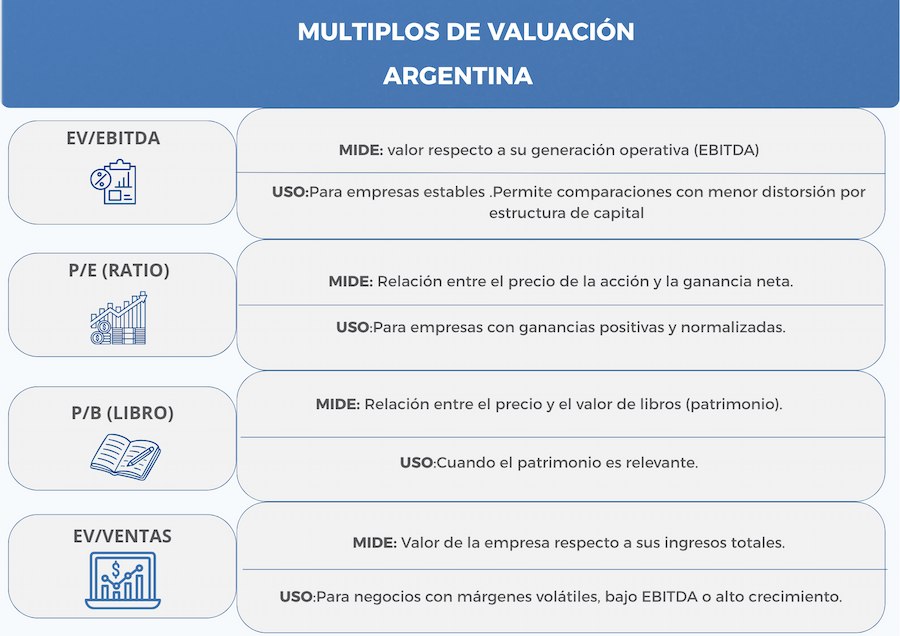
Within the market approach, multiples allow for comparing a company with other companies or benchmark transactions. Generally speaking, the most commonly used valuation multiples are those that relate the value of the business or assets to operating, equity, or revenue variables. In public documents from the Argentine market, it is common to see references such as EV/EBITDA, P/E and, depending on the sector, also EV/Sales as contrast multiples.
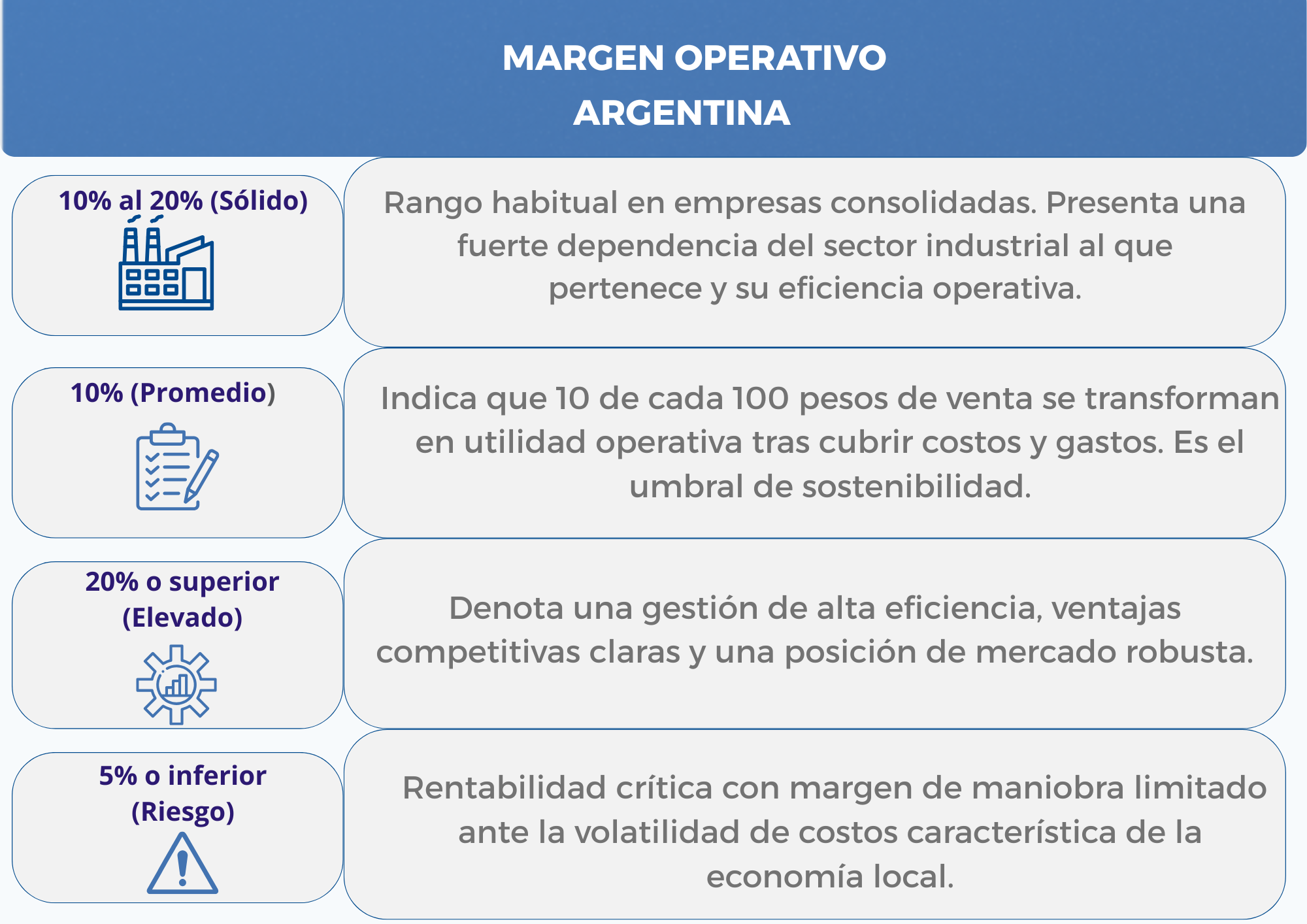
In the field of business valuation in Argentina, there is no available single or standardized operating margin, given that this exhibits significant variations depending on the sector of activity, the size of the company, its cost structure and the macroeconomic context, especially inflation.
The most rigorous methodology for a professional valuation consists of comparing the historical performance of the business with specific market benchmarks and comparables, rather than postulating a generalized margin.
However, in the current context, the following reference ranges can be considered, duly adjusted for the inflationary challenges inherent in the local environment:
Practical example: how an SME can be valued using EV/Sales
A company with adjusted annual sales of $500 million It could be analyzed, preliminarily, using a multiple of 0.4x EV/Sales. In that case, the company's value would be around $200 million.
If the company also had net financial debt of $50 million, the estimated value of the partners' equity would be approximately $150 million.
This type of calculation is useful as an initial reference point in a valuation process, although it should be complemented with a more in-depth analysis to arrive at a more consistent conclusion. The multiple used in this example is merely illustrative and should not be taken as a uniform reference for all sectors.
anepsa global
With Anepsa Global, you can perform this and other types of valuations. Contact us by leaving your information or sending us a message through our social media channels. We're here to advise and guide you so you know which type of valuation best suits your needs.